[polylangic]



Mechanical System Dynamics
Development of numerical and experimental methodologies in three major topics. The first is related to modeling and analysis of dynamic systems, with emphasis on non-linear dynamics and chaos, wave propagation in mechanical systems, vibration control, and modeling and quantification of uncertainties. The second is related to identification in vibrations and acoustics, encompassing inverse problems based on model updating and Bayesian inference, as well as applications involving damage detection in structures. The third topic focuses on modeling, simulation, and experimental analysis of intelligent structures subjected to dynamic loads, especially mechanical systems made of intelligent materials (shape memory alloys and piezoelectric materials) for vibration control and energy harvesting.
This research line is conducted by the Group of Dynamics of Systems, whose members accredited in our graduate program are:
Energy and environment
The Energy and Environment Laboratory is dedicated to applied and fundamental research in energy conversion systems and its associated environmental issues. The research topics include systems for wind, hydrokinetic, and water conversion, photovoltaic and heliothermal energy, internal combustion engine, gas turbine cycles, carbonation, hybrid systems for energy conversion, bio-PCMs, energy management, life cycle assessment, environmental sciences, and sustainability. Fundamental aspects are investigated in subjects related to heat transfer and thermodynamics, such as natural and mixed convection over surfaces or in enclosures, combustion modeling, environmental flows, and multiphase flows in micro heat exchangers.
This research line involves the following professors accredited to our graduate program:
-
Armando de Azevedo Caldeira Pires
Fatigue, Fracture, and Materials
Development of theoretical, experimental, and numerical research on the durability of components and structures subjected to cyclic loads, with particular expertise on the following topics: fatigue in couplings under fretting conditions, fatigue of overhead conductors, multiaxial fatigue, wear, ductile fracture, damage mechanics, structural reliability, and boundary element methods.
This research line has strong interaction with researchers in materials science, especially in applications involving the characterization of metallic, ceramic, polymeric, composite, and smart materials, as well as biomaterials. The applications include sensors, fuel cells, automobile parts, and sustainable products.
The research has been carried out with a strong partnership with national and international companies (Safran Aircraft Engines, TBE – Brazilian Energy Transmission, Taesa, Eletronorte, Galp) and universities of international excellence (Université Paris-Saclay, KU Leuven University, University of Parma, Durham University, Lulea University of Technology, University of Alberta, Higher Technical Institute of Lisbon). The works have a high level of internationalization also involving several dissertations supervised in the context of a double degree system.
The research in Fatigue, Fracture, and Materials relies on facilities comparable to those in the best laboratories of the world, including four machines for axial tests, two machines for axial-torsional tests, and other two machines for fretting fatigue tests, as well as equipment for thermal analysis, chromatography, and spectroscopy. We are also equipped with three spans for fatigue testing of overhead conductors, the only one available in the Southern Hemisphere, in addition to two furnaces to perform fatigue tests at high temperature, scanning electron microscope, and laser confocal microscopy.
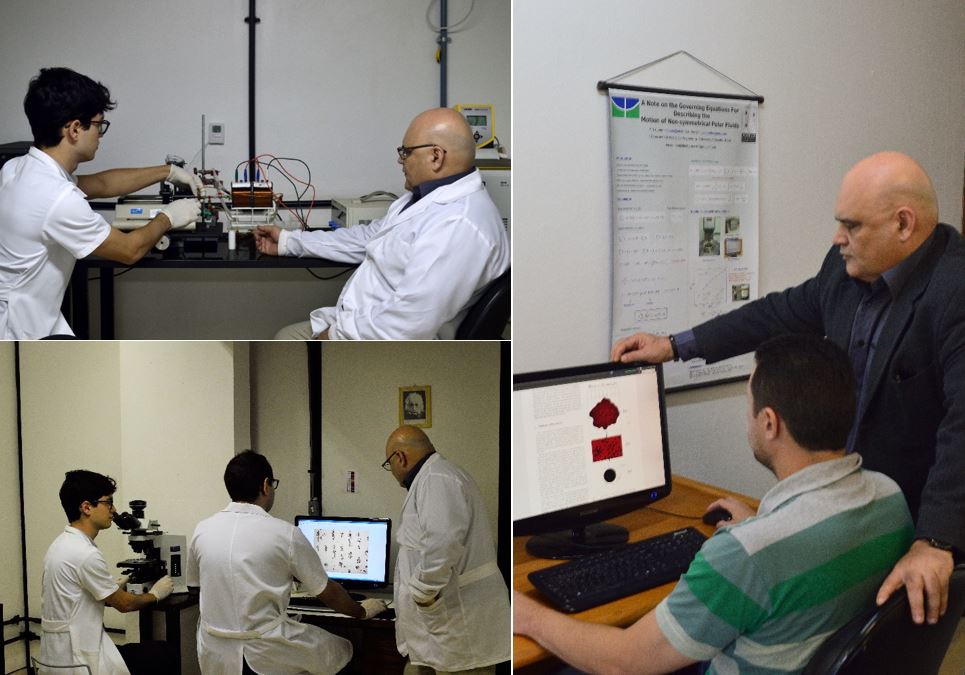
Fluid Mechanics of Complex Flows
Pesquisas teóricas, numéricas e experimentais desenvolvidas na área de Microhidrodinâmica e Reologia de Fluidos Complexos. Os tópicos mais específicos de interesse do grupo VORTEX são: microhidrodinâmica e reologia de fluidos complexos envolvendo partículas ativas e passivas em suspensões, dinâmica de fluidos não-newtonianos envolvendo emulsões e sistemas coloidais em geral, escoamentos de materiais granulares, flutuações de velocidade e dispersão hidrodinâmica em suspensões em sedimentação ou cisalhamento, estabilidade de leitos fluidizados e dinâmica de bolhas em fluidos complexos. A pesquisa desenvolvida pelo grupo é altamente interdisciplinar. Com essa perspectiva o grupo VORTEX visa o desenvolvimento de procedimentos sistemáticos para o estudo de fenômenos em escoamentos complexos, buscando sempre examinar aspectos microestruturais na resposta microscópica de escoamentos e no consequente repasse dos conhecimentos gerados para o setor industrial.